Hello! I'm Nick
I am broadly interested in evolutionary biology and phenotyping colorful creatures, especially birds. I combine light microscopy, Raman spectroscopy, HPLC, UV-vis reflectance spectrometry, and electron microscopy to elucidate the mechanisms of color production in animals. I use the phenotypic information that I gather to better understand speciation, sexual selection, and the genetic basis of coloration in animals.
News!
-
April 2025 - Joined the Stoddard Lab and started a postdoctoral research position at Princeton University!
-
April 2023 - Started postdoctoral research position at Swansea University!
-
April 2022 - Copepod eyespot coloration manuscript accepted at the Journal of the Royal Society Interface!
-
October 2021 - Cotinga coloration manuscript accepted at the Biological Journal of the Linnean Society!
-
November 2020 - Passed comprehensive exams!
-
January 2020 - Awarded 2nd place by The Crustacean Society in the Best Student Oral Presentation Competition at SICB in Austin, Texas!
-
February 2019 - Awarded The Alabama Ornithological Society’s Dan C. Holliman Research Fund!

Nicholas M. Justyn, PhD
Postdoctoral Research Associate,
Princeton University
Email:
Address:
106A Guyot Ln
Department of Ecology and Evolutionary Biology
Princeton University
Princeton, NJ 08544


Current Research
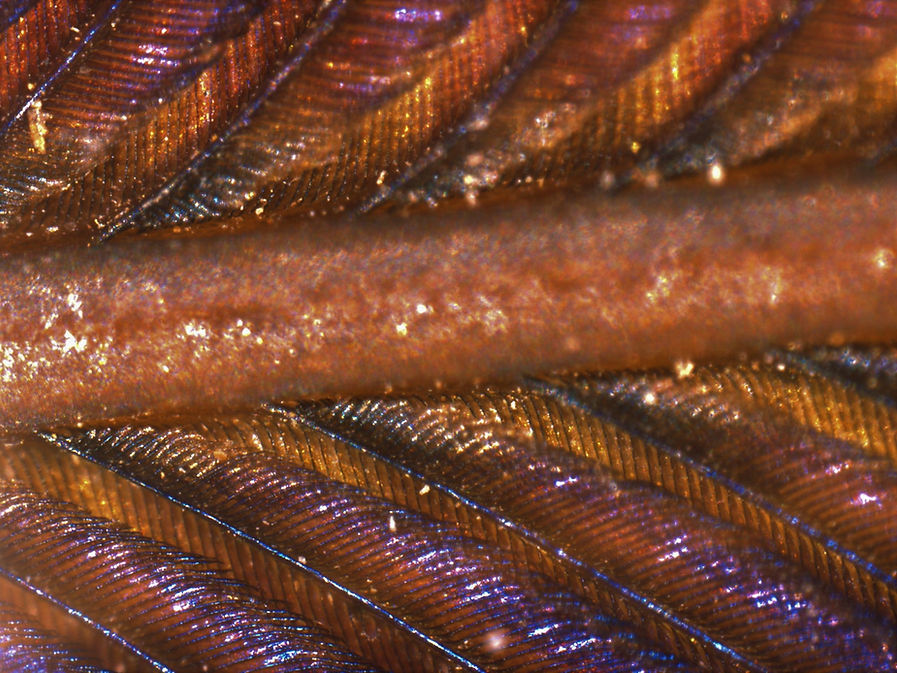
Development of Iridescent Feathers

Working with a fantastic team, I am hoping to help elucidate how iridescent feathers develop, and more specifically, what differences in development result in the production of different iridescent colors.
Characterizing Iridescent Variation
There are currently many examples for how different iridescent feather colors are produced, yet there few which detail how tiny differences within the feathers can result in dramatic color shifts. I am applying my experience with electron microscopy and chemical techniques to detail key differences between iridescent feathers.

Primate Natal Coat Coloration

I am investigating the form and function of conspicuous natal coat coloration in primates. This process involved reaching out to collaborate with zoos and wildlife sanctuaries around the world to establish a photograph database that captures changes in infant natal coat coloration over time. Then, I worked to develop a pipeline in MATLAB to measure the color of the mothers and infants, while accounting for different visual systems.
Publications


14. Lim, H. C., Bennett, K. F., Justyn, N. M., Powers, M. J., Long, K. M., Kingston, S. E., ... & Braun, M. J. (2024). Sequential introgression of a carotenoid processing gene underlies sexual ornament diversity in a genus of manakins. Science Advances, 10(47), eadn8339.
13. Hooper, D. M., McDiarmid, C. S., Powers, M. J., Justyn, N. M., Kučka, M., Hart, N. S., ... & Griffith, S. C. (2024). Spread of yellow-bill-color alleles favored by selection in the long-tailed finch hybrid system. Current Biology, 34(23), 5444-5456.
12. Justyn, N. M., Powers, M. J., Hill, G. E., Alexander, K., Naveda-Rodríguez, A., & Rush, S. A. (2023). The mechanisms of color production in black skin versus red skin on the heads of New World vultures. Avian Research, 14, 100071.
11. Justyn, N. M and Weaver, R.J. (2023). Painting the Bunting: Carotenoids and structural elements combine to produce the feather coloration of the male Painted Bunting. Ornithology, 140(1), ukac052.
10. Louleb, M., Galván, I., Latrous, L., Justyn, N. M., Hill, G. E., Ríos, A., and Zougagh, M. (2022). Detection of porphyrins in hair using capillary liquid chromatography-mass spectrometry. International Journal of Molecular Sciences. IN REVIEW.
9. Justyn, N. M.*, Heine, K. B.*, Hood, W. R, Peteya, J. A., Vanthournout, B., Debruyn, G., Shawkey, M. D., Weaver, R. J., and Hill, G. E. (2022). A combination of red structural and pigmentary coloration in the eyespot of a copepod. Journal of the Royal Society Interface. IN PRESS.
*Both authors contributed equally to this study.
8. Justyn, N. M., Nallapaneni, A., Parnell, A. J., Karim, A., and Shawkey, M. D. (2022). A synergistic combination of structural and pigmentary colour produces nonspectral colour in the Purple-breasted Cotinga (Cotinga cotinga). Biological Journal of the Linnean Society. https://doi.org/10.1093/biolinnean/blab144
7. Justyn, N. M., Callaghan, C. T., & Hill, G. E. (2021). A response to estimating hybridization in the wild using community science data: a path forward. Evolution. https://doi.org/10.1111/evo.14390
6. Hill, G. E. and Justyn, N. M., (2021). Response to: Estimating hybridization rates in the wild: easier said than done? Evolution, 75-8: 2145-2147. https://doi.org/10.1111/evo.14276
5. Heine, K. B., Justyn, N. M., Hill, G. E., & Hood, W. R. (2020). Ultraviolet irradiation alters the density of inner mitochondrial membrane and proportion of inter-mitochondrial junctions in copepod myocytes. Mitochondrion, 56, 82-90.
4. Justyn, N. M., Callaghan, C. T., & Hill, G. E. (2020). Birds rarely hybridize: A citizen science approach to estimating rates of hybridization in the wild. Evolution.
3. Hill, G. E., Hood, W. R., Ge, Z., Grinter, R., Greening, C., Johnson, J. D., Park, N. R., Taylor, H. A., Andreasen, V. A., Powers, M. J., Justyn, N. M., Parry, H. A., Kavazis, A. N., & Zhang, Y. (2019). Plumage redness signals mitochondrial function in the House Finch. Proceedings of the Royal Society B, 286(1911), 20191354.
2. Hsiung, B. K., Justyn, N. M., Blackledge, T. A., & Shawkey, M. D. (2017). Spiders have rich pigmentary and structural colour palettes. Journal of Experimental Biology, 220(11), 1975-1983.
1. Justyn, N. M., Peteya, J. A., D'Alba, L., & Shawkey, M. D. (2017). Preferential attachment and colonization of the keratinolytic bacterium Bacillus licheniformis on black-and white-striped feathers. The Auk: Ornithological Advances, 134(2), 466-473.

![Flying Squirrel Fur[1360].jpg](https://static.wixstatic.com/media/174c3b_e5427fda6aaa4401b8cd994cef0385a2~mv2.jpg/v1/crop/x_0,y_690,w_3024,h_3342/fill/w_169,h_181,al_c,q_80,usm_0.66_1.00_0.01,enc_avif,quality_auto/Flying%20Squirrel%20Fur%5B1360%5D.jpg)